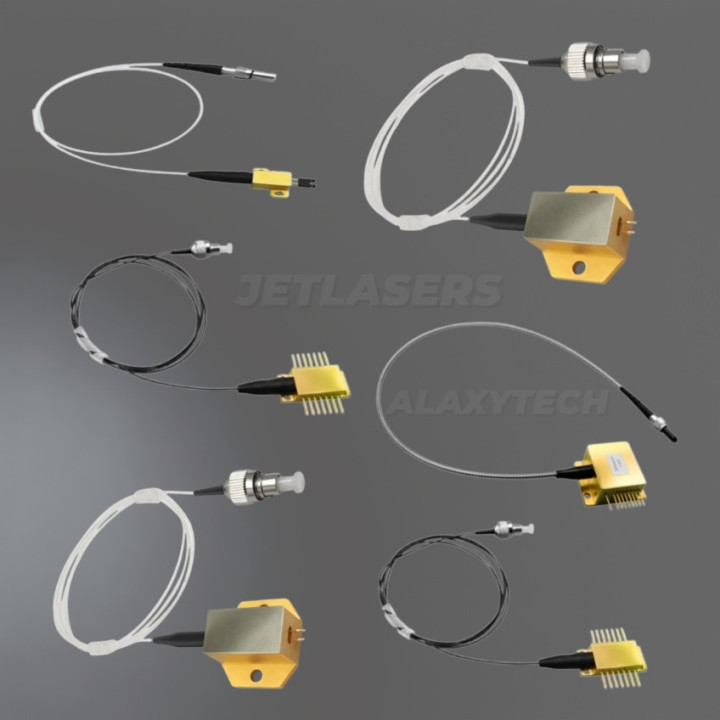
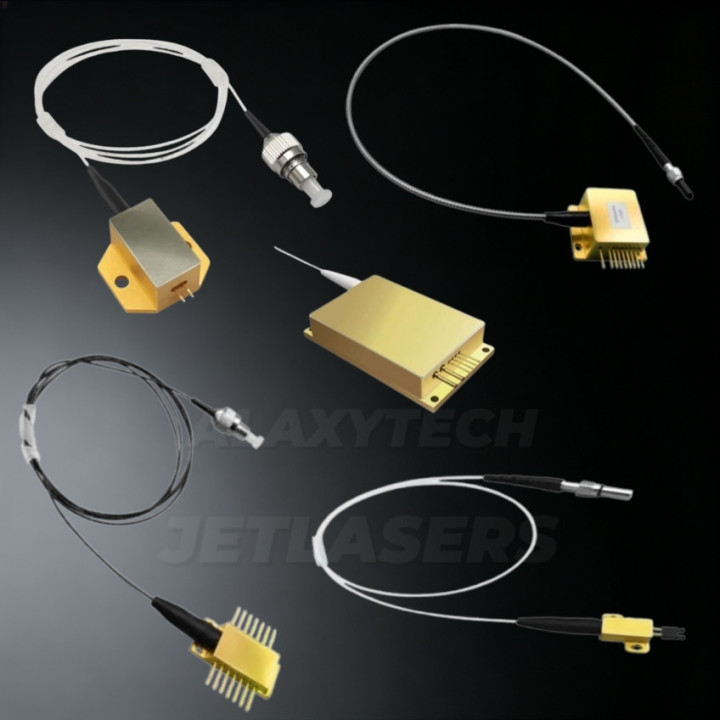
Fiber-coupled laser diodes are widely used across industries, thanks to their flexible, low-loss light delivery via optical fiber.
 Quality guarantee
Before we ship your order, we have to prepare your products, do strict quality-control tests.
 Delivery policy
We ship worldwide by Fedex/UPS. The average delivery time is 6-7 days.
 Return policy
JETLASERS offer a refund for most items within 7 days of receipt of shipment.
| Type | Typical Power | Wavelengths | Primary Uses |
|---|---|---|---|
| Pump Modules | 1–30 W | 808 nm, 915 nm, 980 nm | Pumping fiber lasers, solid-state lasers, EDFAs |
| Visible Lasers | 10 mW–5 W | 450 nm, 520 nm, 650 nm | Alignment, display, fluorescence, medical therapy |
| Infrared Lasers | 10 mW–50 W | 1064 nm, 1310 nm, 1550 nm | Sensing, spectroscopy, optical communications |
Fiber-coupled laser diodes are widely used across industries, thanks to their flexible, low-loss light delivery via optical fiber. Below are their most common applications, organized by field:
1. Laser Pumping (The Largest Industrial Application)
FCLDs are the "heart" of most fiber and solid-state lasers, serving as pump sources to excite gain media.
- **Pumping solid-state lasers**: 808 nm (1–30 W) diodes pump Nd:YAG/Nd:YVO₄ crystals for marking, cutting, and medical lasers.
- **Pumping fiber lasers/amplifiers**: 915/940/980 nm (1–20 W) diodes pump ytterbium/erbium-doped fibers for industrial processing and optical amplification (e.g., EDFAs in telecom).
- **Key advantage**: High wall-plug efficiency and long-term power stability for continuous operation.
2. Industrial Materials Processing
Direct use as light sources for manufacturing and fabrication.
- **Marking & engraving**: 520 nm green or 1064 nm infrared modules provide stable light for precision marking on metals, plastics, and ceramics.
- **Micro-welding & soldering**: High-power 915/980 nm modules deliver controlled heat for joining small components in electronics and medical devices.
- **3D printing/additive manufacturing**: 450 nm blue or 915 nm infrared modules power selective melting of metal/polymer powders.
- **PCB processing**: UV/blue modules for drilling, cutting, and trimming electronic circuits.
3. Medical & Life Sciences
Fiber coupling enables safe, precise light delivery to tissues or through endoscopic tools.
- **Photodynamic therapy (PDT)**: 630/652 nm red modules activate photosensitizers for cancer treatment.
- **Ophthalmology & dermatology**: 532 nm green, 810 nm, or 980 nm infrared modules are used for retinal photocoagulation, vascular therapy, and hair removal.
- **Dental procedures**: 450 nm blue or 810 nm infrared modules for cavity preparation and disinfection.
- **Fluorescence excitation & microscopy**: 405 nm violet, 488 nm blue, 520 nm green, or 638 nm red modules serve as light sources for confocal microscopes and flow cytometers.
4. Optical Communications & Sensing
FCLDs are foundational components of modern telecom and sensor systems.
- **Optical fiber communications**: 1310/1550 nm modules act as transmitters in data networks; 980/1480 nm modules pump erbium-doped fiber amplifiers (EDFAs).
- **Fiber-optic sensing**: Narrow-linewidth 1550 nm modules for distributed temperature/strain sensing; 785/850 nm modules for gas detection and Raman spectroscopy.
- **LiDAR & ranging**: 905/1550 nm modules serve as light sources for autonomous vehicles, surveying, and industrial distance measurement.
5. Scientific Research & Laboratory Equipment
FCLDs provide stable, wavelength-specific light for experimental setups.
- **Spectroscopy**: 785 nm for Raman spectroscopy; 405/532 nm for fluorescence analysis.
- **Atomic & quantum optics**: Narrow-linewidth, single-frequency modules for atom cooling, trapping, and quantum communication experiments.
- **Education & demonstrations**: Low-power visible modules for teaching optics and laser physics principles.
6. Specialized Applications
- **Laser projection/displays**: RGB (450/520/638 nm) fiber-coupled modules for compact, high-brightness projectors.
- **Security & non-lethal deterrence**: 520 nm green modules in dazzler systems for law enforcement and maritime use.
- **Isotope separation & advanced research**: Custom wavelength modules for specialized physics and chemistry experiments.
check_circle
check_circle



Comments (0)
Your review appreciation cannot be sent
Report comment
Report sent
Your report cannot be sent